
Tom is our program coordinator at Better Me, our host in Kenya. He also became a good friend of mine. Apart of our social work he also supports volunteers to learn more about his country by organising trips such as to the Maasai Mara National Reserve Park. Volunteers appreciate these experiences outside of the “Korando bubble”, where they usually stay. Tom is very well connected, there is (almost) no problem or request he could not solve. For us, he has organised a weekend trip to Jinja, Uganda. That’s around four hours by car, the border isn’t far away from Kisumu. He even joined us. For foreigners it requires the East Africa Tourist visa which allows multiple entries between Kenya, Uganda and Rwanda. At least at the time of our stay. Better Me recommends such a trip as part of any volunteer’s personal preparation.

The entire journey was very interesting and basically unusual. For the first time I have crossed a border in Africa. The procedure was interesting. All the military presence at the border did not scare me at all, not at last because Tom was with us all the time and he made us feel super comfortable. A great man and superb host. Really. Naturally, he could handle all the things, including a Ugandan prepaid SIM card, not available for foreign tourists. He used the SIM card in an additional phone as our internet hot spot. That’s nice. I have already learned that East African people mostly speak the same language, Swahili. From Tanzania to Kenya to Uganda and in other regions. It has helped us a lot but it shall take a while until I understand this language. Currently I am taking courses.
However, I have noted armed security personal also in front of every ATM, in front of larger companies, shops or restaurants as well as outside of gated communities. Much more than in Kenya. Uganda, as many other African countries, is a poor country. There’s more poverty compared to Kenya but the people are super friendly as in Kenya. According to Tom, a Kenyan citizen feels kinda rich in Uganda. Products and services are cheaper for Kenyans in Uganda. I am not sure how it would look like without the security personal but it appeared weird to me. You better do not take pictures at these places. 😉
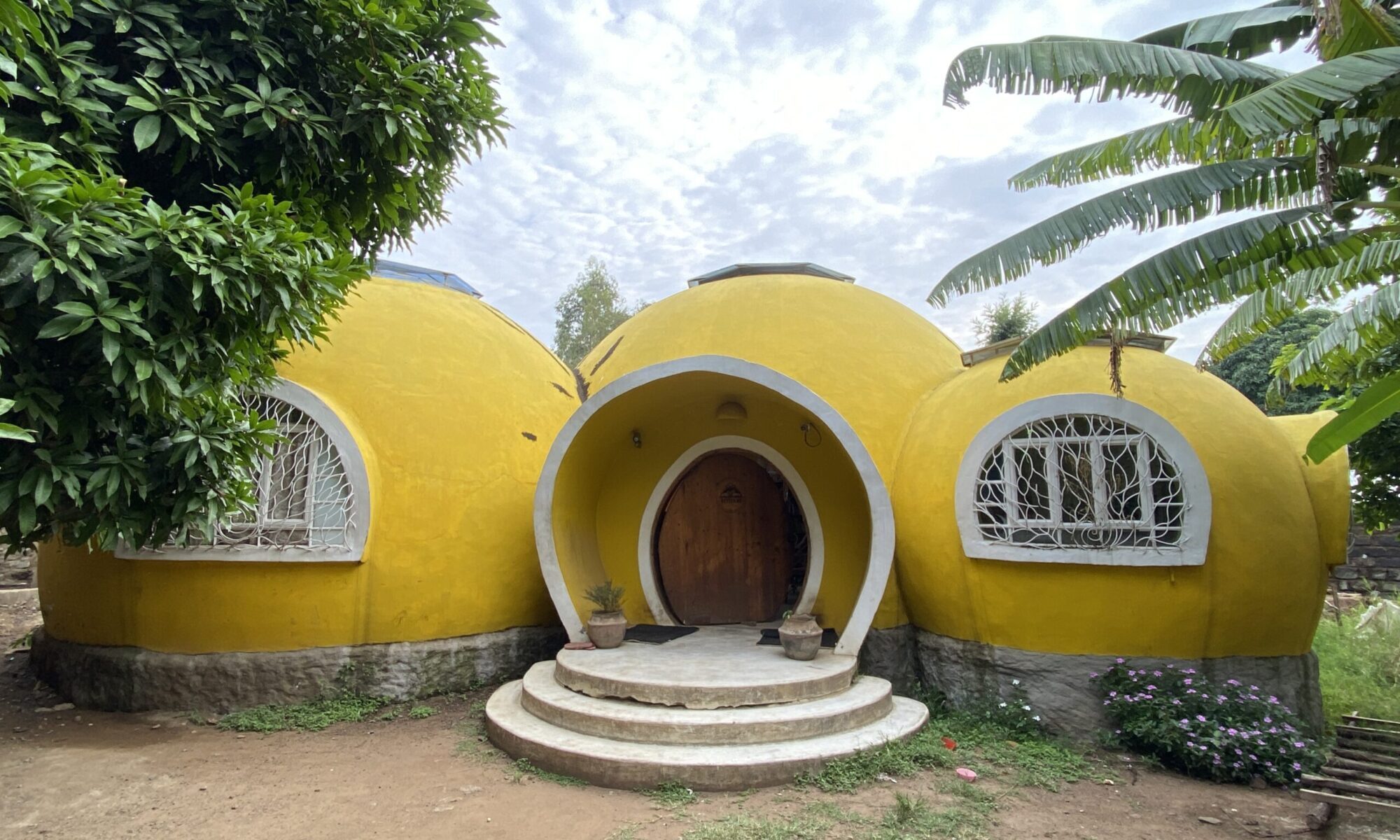
Our first morning and day has started with a lot of rain while we drove around. Our hotel was outside of the town, actually a village in the outlaying suburbs. Those appeared to be less prosperous compared to the town, at least from what we could see from our car. It does not mean that our impressions are representative in any way. But we got a first impression about life on the countryside, along a busy transit road. That’s literally a marketplace from morning to evening as you may have seen it from other places on this planet.
We even met a cyclist on his way. In social media there are some stories shared by cyclists who are on a longer trip by bicycle in Africa. Inspiring. And not comparable with our charity bicycle tour from Berlin to Paris. But now that I have witnessed one of those cyclists I have made the decision to explore parts of Africa by bicycle as well. Soon. Very soon. 😁


Some spots we planned to visit could not be visited. For example a waterfall, which is now a hydroelectric power station, not accessible to the public. 😬
The route took us through several villages. Short clips give an idea of the life along the transit route (where our hotel was) as well as on the countryside.
But there was still something to see. Jinja is located at the northern end of the Lake Victoria and is also known as the “Source of the Nile”. Yes, the White Nile, the minor of the two main tributaries of the Nile, the larger being the Blue Nile. According to Wikipedia, the name “White” comes from the clay sediment carried in the water that changes the water to a pale colour. In the strict meaning, “White Nile” refers to the river formed at Lake No, at the confluence of the Bahr al Jabal and Bahr el Ghazal Rivers.

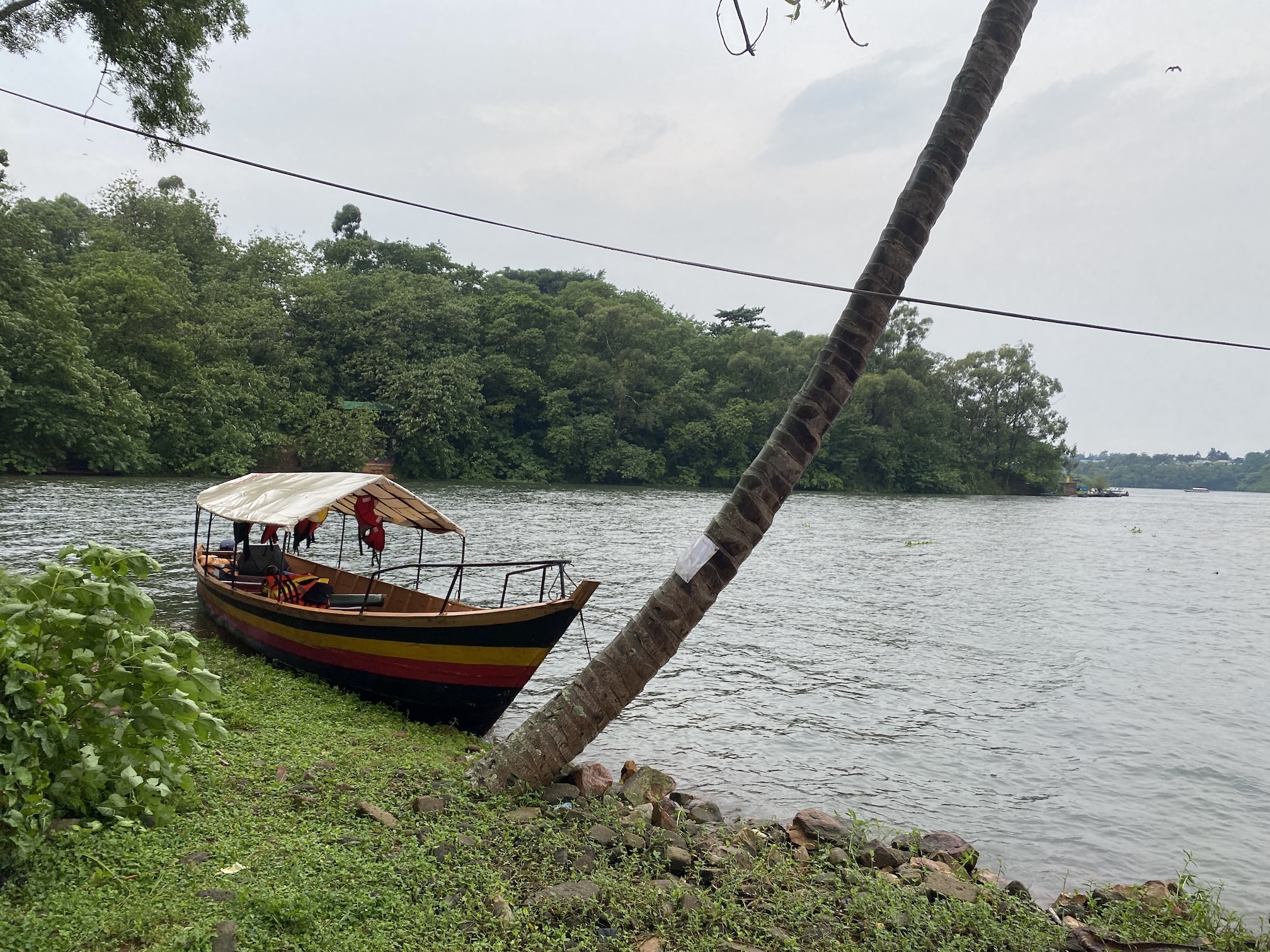
The White Nile river that eventually turns into the Nile river has its source at the northern End of the Lake Victoria. We have visited the river’s source itself from several points of view and we also set over to an artificial island in the middle of the river. This was a great highlight, including some insights about the local natural environment provided by a local guide.


At this time the water level was unusually high. We have already learned that the January (in 2024) was the rainiest in that region since quite some time. It impacts the Lake Victoria water level too. Anyway, despite of a dispute between scientists, the White Nile river is evidently the world’s longest river, river system more precisely.


Other than that, we could enjoy nice landscapes during our car drives from village to village. We also witnessed poverty and basic circumstances. Not all the time, but it appeared to be more compared to Kenya. Especially on the Ugandan countryside. To me it was a visible difference compared to Kenya. For lunch we were guests in a small village, near the river’s source, following the boatswain’s recommendation. The same man with whom we took the boat to the island on the river. I remember it was a tough negotiation between him and Tom. Most likely because of the weather and our skin colour which – apparently – leads to higher prices in Africa often times. No surprise.
We went to a village that looks like in a Western movie or so. Apart of that, anything was different and far away from what Western people would take as a standard. Tom has ordered a large meal for us, done by a local butcher: a lot of meat, baked bananas and avocados. And a snack known as “Rolex”, because it is a rolled wrap, made of scrambled eggs, meat and cabbage.


It took some time but it was a huge and crazy meal, but also super tasty. Prepared by a local butcher. Including pork, baked bananas, avocados, rolled pancakes and drinks for 6 people. We paid less than 20 EUR and still had a lot of leftovers being donated to local people. According to Tom things are much cheaper in Uganda even for Kenyans. Still, people are super friendly and open minded. We appreciated that.

Later we went for some zip line adventure with a special view to the White Nile river and the Lake Victoria. However, I could not do this due to an injury from a few days before but I could enjoy the view and relax instead. Nice.

On the next day we have visited the Railway Museum in Jinja. Quite some time ago the railway system from Mombasa to Kisumu was important to Uganda as it has opened the the door to international trade for Uganda. Without access to the sea, this landlocked country relies on transport through Kenya, which was visible on our way in both directions, to and from Kenya. Lack of sea access is the reason for the transit traffic on the road between Kisumu, Kenya and Jinja (and further). That includes a huge number of gasoline transports, departing from the gas pipeline in Kisumu (the other end of a pipeline from Mombasa via Nairobi).

Currently there are high efforts to re-establish the railway system. During the colonial period the British ruler brought a load of workers from India, also under British rule at this time. Those workers from India had laid the railway track from Uganda to Kisumu and within Kenya. Before that, however, Uganda did not have access to the world market. Once the railway conection was established, Ugandan farmers were able to sell cotton worldwide. The Indian workers making this possible had been given a choice: either having a paid ticket home to India or being allowed to settle in East Africa. Nearly 7,000 workers took the second option, to stay there option. As a result, Indians became middlemen in the cotton trade. By 1925 they owned about three-quarters of the cotton ginneries in the country, a subject of growing resentment by the African population.For a long time, ships were used for transportation between Kisumu and Uganda, upon the Lake Victoria. Later a railway system was established in Uganda as well. Even Winston Churchill visited this place. This is something fascinating to me.


In the afternoon we went for a walk in Jinja. I was told we were in the inner city, in a tourist district, but I barley saw any tourist. Indeed, along the Main Street I could see a lot of shops and some hotels where white people enjoyed a drink. But it’s apparently not a tourist hot spot according to a woman whom I have met in front of a hotel. She offered some homemade crafts and we talked for a little. Indeed I’ve got something nice, for example some painted postcards and another wristband featuring the Ugandan colours. The first flexible one that I ever saw, one can take it on and off again. Even our children at Korando were surprised and wanted to learn how that works. Lastly, I got a new football for our Korando kids – in Jinja.

It’s nice in Jinja but apparently there isn’t very much to see. In addition to some modern buildings, there are also some post-colonial-style buildings and some rather dilapidated houses. Evidence of a different time. Either way, there’s a lot of activity in this area though.


Yes, these things are snapshots, taken in a limited time and area. Can’t wait to see more of the country, for instance Kampala, the capital, as I always want to see the capital of any country that I am going to visit. And I want to see Entebbe, another big city, with the only international airport in Uganda (Mbarara Airport offers domestic flights only).
And after sunset, always after 6 p.m., it’s literally pitch black. There’s hardly any street lighting, not even in town (Jinja). Yes, there are some streetlights in Jinja, but not much. Less than in Kenya, far less than at home. In some places, there are no sidewalks or they’re in poor condition. And poverty was still visible. A flashlight is absolutely essential since there’s some more light only at market stalls, for instance along the main road, still a crowded place at this time of day. And a few houses are illuminated by LED. These are some of the less pleasant circumstances people have to deal with. Thought about it a lot of times, what a difference compared to our home countries. That indeed has caused a lot of thoughts for several times for quite some time.
The last afternoon we enjoyed hanging around at a resort with a public restaurant. Chats, drinks, playing cards, live music. A nice wrap-up. This place seemed to be a famous place visited by tourists and wealthy (local) people. Often times we noted people from African countries however it was hard if not impossible to distinguish whether those were wealthy Ugandan people or African tourists. Like in Europe, just a different skin colour…


Oh, and I loved that (local) beer. Definitely recommended. Cheers! 🍻 😁

Leave a Reply